The triaxial shear frame hums in our loading bay while a 2.8-inch Shelby tube sample from a downtown Portland project site waits under the membrane. We saturate the specimen, apply confining stress matching the depth where the Willamette silt was extracted, and run the consolidated-undrained stage. With Portland’s shallow groundwater hovering just 8 to 15 feet below grade across much of the central eastside, effective stress parameters matter more than total stress approximations. Our triaxial cell generates the Mohr-Coulomb envelope that feeds directly into bearing capacity equations under IBC Chapter 18. The team logs every pore-pressure increment, knowing that foundation decisions for a five-story mixed-use building in the Pearl District ride on a clean failure plane.
Portland’s soil memory includes Missoula Flood deposits that still consolidate today, which is why we run staged oedometer tests past the in-situ preconsolidation pressure every time.
Service characteristics in Portland Oregon
Local geotechnical conditions in Portland Oregon
Portland’s street grid expanded rapidly after the 1905 Lewis and Clark Exposition, but much of the inner eastside was built on filled sloughs and buried creeks that no longer appear on any city map. Tanner Creek still flows through a culvert under the Pearl District, and its historic floodplain now hosts mid-rise structures with deep basements. When an excavation reaches the transition from fill to native silt, the cut can daylight a seepage path that softens the subgrade within hours. We measure hydraulic conductivity on undisturbed samples because the difference between 10⁻⁵ cm/s and 10⁻⁶ cm/s dictates whether a dewatering system can handle the inflow or the contractor faces a flooded footing. Portland’s seismic setting, with the Cascadia Subduction Zone capable of a magnitude 9 rupture, means our laboratory reports always include a discussion of cyclic degradation of silt strength under long-duration shaking.
Our services
Every soil mechanics study we deliver for Portland projects includes laboratory index testing, strength evaluation, and a geotechnical interpretative report that addresses the city’s specific subsurface hazards. The two work packages below form the backbone of our approach.
Laboratory Strength and Consolidation Program
We run multi-stage triaxial tests (CU and CD) on Shelby tube specimens recovered from Portland’s Willamette silt and Troutdale formation. Consolidation curves from incremental oedometer loading, paired with Atterberg limits and grain-size distributions, allow us to calculate settlement magnitude and rate under the actual footing geometry. All results are reported with ASTM D2487 classifications and IBC presumptive load-bearing values where applicable.
Site-Specific Seismic and Liquefaction Assessment
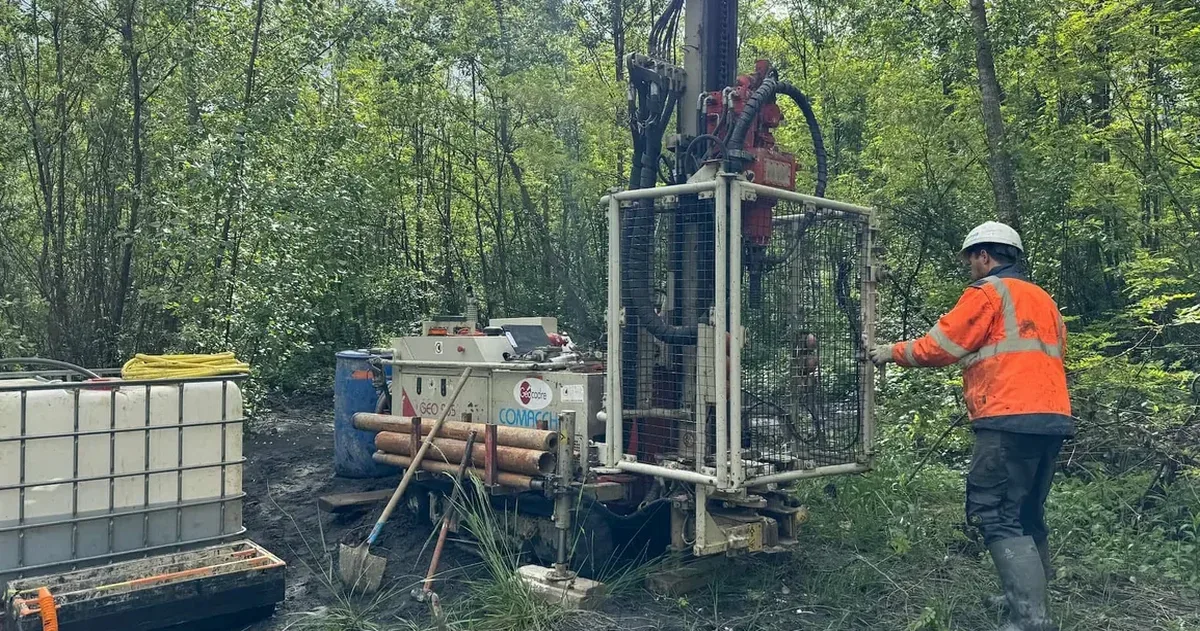
Using SPT data from our drilling crew or your exploration logs, we compute factor of safety against liquefaction per the Seed-Idriss method with fines-content corrections. For sites within Portland’s mapped liquefaction hazard zones, the report includes post-liquefaction settlement estimates and recommendations for ground improvement or deep foundation alternatives where FS drops below 1.1.
Common questions
What soil mechanics parameters does the City of Portland require for a building permit?
The Bureau of Development Services expects a geotechnical report with bearing capacity, total and differential settlement estimates, and lateral earth pressures for retaining structures. For sites in seismic design category D, the report must address liquefaction potential per ASCE 7-22 and provide site class determination based on SPT or shear-wave velocity data. Our laboratory program generates every parameter needed to satisfy these submittal requirements.
How long does a full soil mechanics study take for a typical Portland infill lot?
Once the Shelby tubes arrive at our lab, index testing (moisture content, Atterberg limits, grain-size) finishes in three to four working days. Consolidation tests run seven to ten days per specimen because we track secondary compression beyond primary. Triaxial shear with pore-pressure measurement adds another five to seven days. A complete report with all strength and settlement parameters is typically ready within three weeks from sampling, though we can expedite select tests for tight permit deadlines.
What’s the typical price range for a soil mechanics study in Portland?
For a standard single-family or small commercial lot in Portland, a comprehensive soil mechanics study including triaxial shear, consolidation, index testing, and a stamped geotechnical report runs between US$3,260 and US$5,020. The final cost depends on the number of Shelby tube samples, whether we need to run multiple consolidation stages, and if a liquefaction screening is required by the city.
Do you classify Portland’s Boring Lava and Troutdale formation correctly for foundation design?
Yes. The Troutdale formation often contains cemented gravel layers that can be mistaken for refusal if only SPT blow counts are considered. We log the cuttings, perform point-load testing on gravel clasts, and classify the matrix according to ASTM D2487. For the Boring Lava, we distinguish between intact basalt, weathered residuum, and colluvium, because each behaves differently under footing load and each requires a separate bearing-capacity check.