A contractor working up near Forest Park ran into a buried basalt float field last spring—nothing on the boring logs, but the backhoe pulled up sub-meter boulders at four feet. That kind of surprise is exactly why we run exploratory test pits in Portland before committing to a foundation cut. The Willamette Valley’s Missoula flood deposits, mixed with colluvium off the West Hills, don’t always show up clean on a split spoon. With a test pit, you see the contact between the Portland Hills Silt and the underlying Troutdale Formation gravel right on the wall. We log strata per ASTM D2487, photograph the face, and grab bulk samples for grain size analysis the same day. For sites east of 82nd where the water table sits high in winter, a pit also tells you where the seasonal saturation line actually sits—something a drill rig can smear right past.
A test pit lets you read the soil like a book—contacts, moisture, cobble content—all visible on a clean vertical face.
Service characteristics in Portland Oregon
Local geotechnical conditions in Portland Oregon
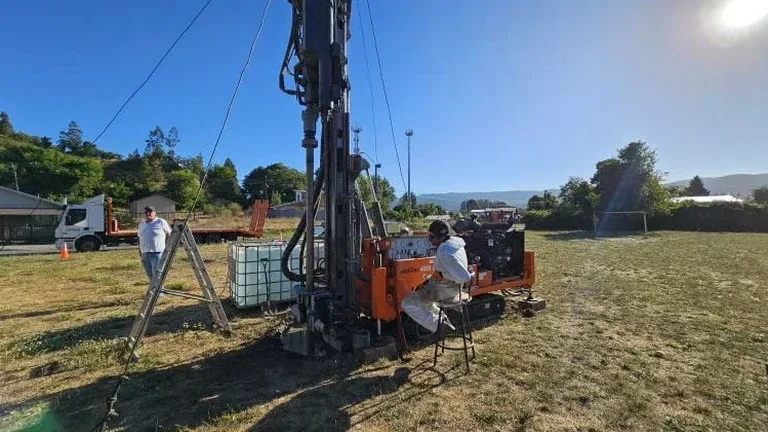
The excavator we run on Portland test pit jobs is a 3.5-tonne zero-tail-swing machine—tight enough for a residential backyard in Sellwood, but with enough breakout force to pop through the desiccated crust on the upper three feet of stiff clay. The real risk here isn’t the digging; it’s the collapse. Portland’s winter rains saturate the upper Port Hills Silt fast, and a vertical face that looked stable at 9 a.m. can slab off by noon. Our operator stays in the cab while the logger is in the pit—spotter on the bank, radio check every five minutes. We also hit buried debris more often than you’d think in close-in neighborhoods: old cesspools, brick rubble from demolished streetcar-era foundations. The pit reveals it; the boring misses it. For deeper profiles, we combine the test pit with spt drilling below the four-foot OSHA limit to carry the stratigraphy down to refusal without risking entry.
Our services
Our test pit work in Portland typically feeds into two parallel investigation tracks—one for soil characterization and one for foundation design parameters. The following services are what we pair most often with exploratory pits in the metro area.
Test Pit Logging and Sampling
Full stratigraphic logging on site per ASTM D2487 with Munsell color notation. We collect bag samples and Shelby tubes from each distinct stratum, photograph the face with scale, and deliver a PDF log within 48 hours for your geotechnical report.
In-Situ Density and Moisture Profiling
Sand cone density testing (ASTM D1556) at multiple depths within the pit to establish dry density and moisture content profiles. Particularly useful for fill compaction verification on Portland’s east-side industrial lots where historical undocumented fill is common.
Common questions
How deep can you go with a test pit in Portland before you need shoring?
Under OSHA Subpart P, a vertical wall in Type C soil—which covers most of Portland’s near-surface silts—is limited to four feet. We can bench the excavation at 1:1 slope to go deeper safely, but for anything beyond about eight feet we typically transition to a drill rig to avoid the footprint of a large benched excavation in tight urban lots.
What does an exploratory test pit cost in the Portland metro area?
A single test pit with full logging, photos, and bulk sampling generally runs between US$560 and US$900, depending on access, depth, and whether we need to haul spoils off-site. Sites with overhead clearance issues or requiring street-use permits from PBOT may push toward the upper end of that range.
Can a test pit replace a boring for a shallow foundation investigation?
Often yes, and the City of Portland BDS accepts test pit logs for residential and light commercial projects when they extend through the bearing stratum and are logged by a qualified geotechnical professional. The advantage over a boring is direct visual confirmation of stratigraphic continuity. That said, we still recommend at least one boring paired with the pit if the site has a history of undocumented fill or variable depth to the Troutdale Formation.