A stack of 8-inch brass sieves sits on a Ro-Tap shaker in our lab, processing material from a Downtown Portland project. The full particle distribution—from gravel to clay—defines how soil will behave under load and in contact with water. Sieve analysis splits the coarse fraction; the hydrometer test settles out the fines. Together they give the exact grain size curve required by the City of Portland's grading code. We see everything from well-graded Columbia River sands to the silts of the Willamette floodplain. Getting the curve right means the difference between a properly designed footing and a future settlement problem. Our technicians run ASTM D422 and D6913 daily on samples from the Pearl District to Gresham, delivering USCS classifications per ASTM D2487 with the precision that geotechnical engineers demand.
A complete grain size curve is the foundation of every USCS classification—without it, you're guessing at drainage, strength, and frost susceptibility.
Service characteristics in Portland Oregon
Local geotechnical conditions in Portland Oregon
Consider two sites: one in the flat terrain of the Columbia Slough and another in the West Hills above Cornell Road. The Slough sample runs 80% silt with high plasticity—fine-grained and water-sensitive. The West Hills sample is a silty sand with gravel, well-drained and stable. If you treat them the same, you'll get the foundation wrong. Missing the fines content in a fill material leads to frost heave on unheated slabs. Overlooking the gravel fraction in a drainage design clogs the system. A complete grain size analysis catches these differences before they become change orders. The hydrometer step is not optional when the #200 wash shows more than 12% fines—skip it and you lose the clay-silt distinction that controls permeability and compressibility.
Our services
We run the full particle-size package—sieve plus hydrometer—on samples from across the Portland metro. Results include the grain size distribution curve, USCS classification, and Atterberg limits when required.
Sieve Analysis (ASTM D6913)
Mechanical shaking through a stack of sieves, from 3-inch down to #200. We wash the fines, oven-dry the retained fractions, and calculate percent passing by weight. Delivers D10, D30, D60, Cu, and Cc.
Hydrometer Analysis (ASTM D422)
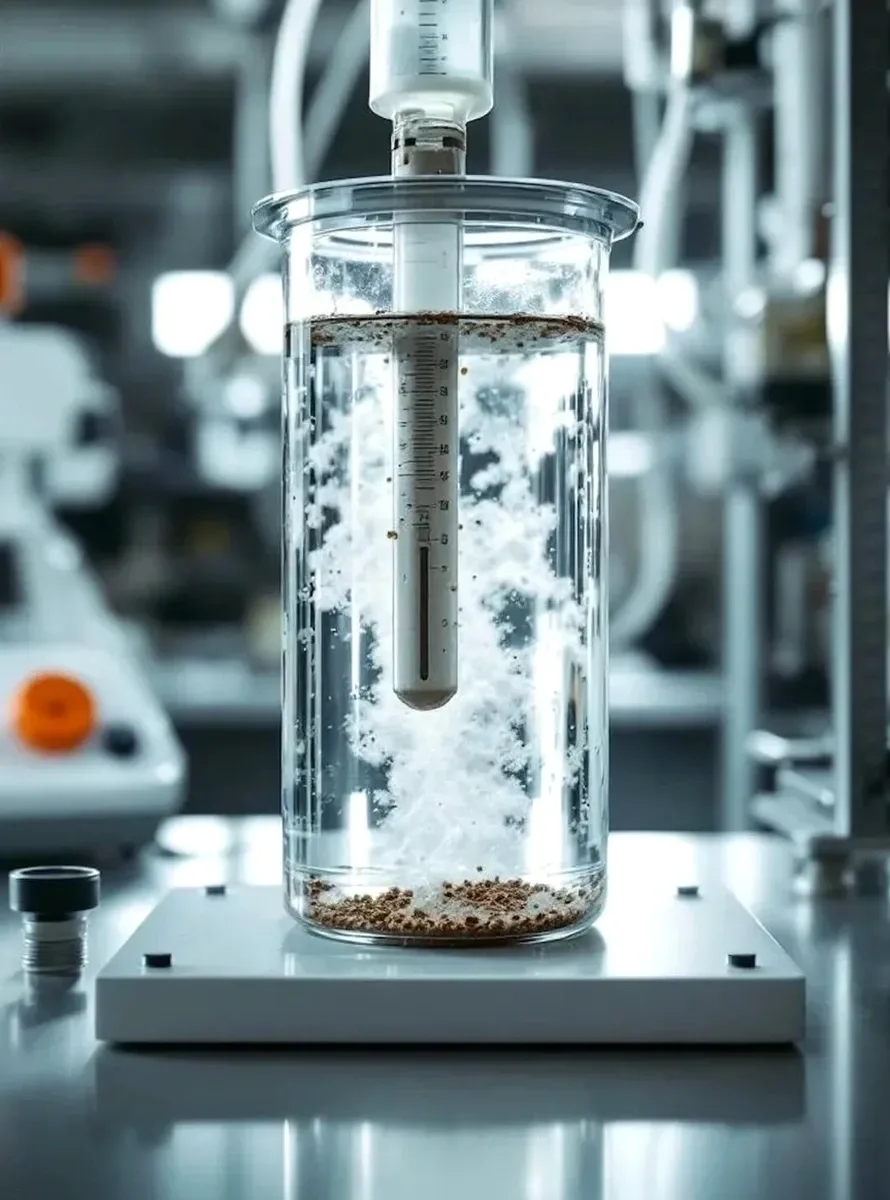
Sedimentation test for the minus #200 fraction. Hydrometer readings over 24 hours determine the silt and clay distribution. Essential for classifying fine-grained soils and predicting drainage behavior.
Common questions
How long does a complete grain size analysis with hydrometer take?
The sieve portion finishes same-day. The hydrometer test requires a minimum 24-hour settling period, plus sample preparation and data reduction. Typical turnaround for the full report—sieve curve, hydrometer curve, and USCS classification—is 2 to 3 business days from sample receipt.
What is the minimum sample size needed for a reliable grain size analysis?
For a combined sieve and hydrometer test, we need about 500 grams of material passing the #4 sieve. If the soil contains gravel, send a larger sample—roughly 2 to 3 kg—so we can split a representative portion without bias.
Do you need the Atterberg limits alongside the grain size analysis?
For fine-grained soils with more than 12% passing the #200 sieve, ASTM D2487 requires both the grain size curve and Atterberg limits (liquid limit and plastic limit) to assign a complete USCS classification. We run both tests from the same sample when needed.
What does a grain size analysis cost for a Portland project?
A complete sieve plus hydrometer package typically runs between US$110 and US$210 per sample, depending on whether Atterberg limits are included. Volume pricing applies for multiple samples from the same project.