The soil profile changes dramatically between Portland's east and west sides. Over in the Alameda Ridge, you hit stiff, overconsolidated loess that holds slopes remarkably well. Cross the Willamette into the Pearl District or the industrial flats near the Columbia Slough, and you're dealing with compressible alluvium and hydraulic fill—material that barely remembers it was once riverbed. A standard penetration test like the SPT drilling service gives you a good index of density, but it won't tell you how the soil behaves under sustained load or rapid shaking. That's precisely where we come in. The triaxial test measures shear strength, effective stress parameters, and pore pressure response under controlled conditions. For Portland projects straddling these stark geological boundaries, getting the stress-strain curve right is the difference between overdesigning a foundation and leaving a critical failure mode unchecked.
Triaxial testing isn't about a single number. It's about the failure envelope that predicts how Portland's floodplain silts will behave during the next Cascadia event.
Service characteristics in Portland Oregon
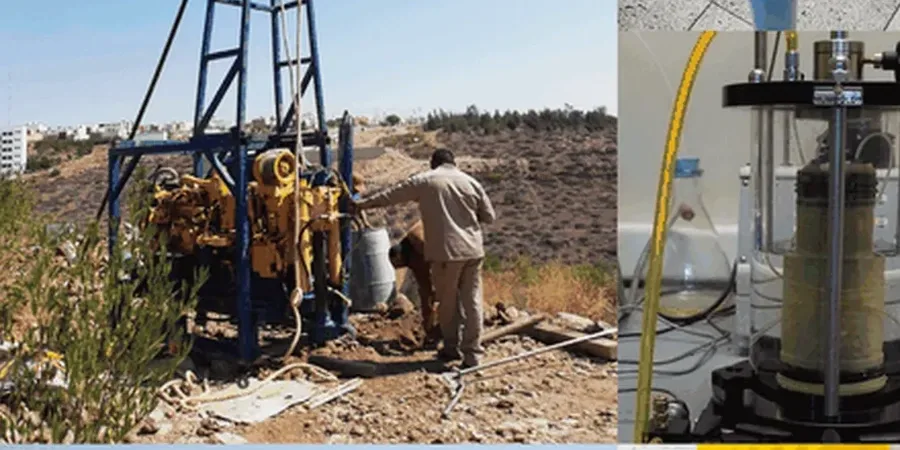
Procedure video
Local geotechnical conditions in Portland Oregon
A 14-story mixed-use project in the Lloyd District ran into trouble a few years back. The geotech report relied on SPT blow counts and a single unconfined compression test on a stiff clay sample. Excavation hit a pocket of sensitive, normally consolidated silt that nobody had characterized for strain-softening. The shoring deflected, and the adjacent light rail embankment showed cracks. That mess cost six figures in mitigation and months of delay. A triaxial test on an undisturbed Shelby tube sample from that depth would have flagged the low residual strength immediately. In Portland, where we stack heavy structures on soft soils in a high-seismic zone, skipping a proper shear strength evaluation isn't a shortcut. It's a gamble with a loading rate that the Cascadia Subduction Zone will eventually settle. We test to define the Mohr-Coulomb parameters so your structural engineer doesn't have to guess what friction angle and cohesion to plug into the model.
Our services
The triaxial test is central to most of our Portland geotechnical investigations. We support it with field sampling and complementary lab work to build a complete picture of the subsurface.
Triaxial Test Program Design
We define the test suite—UU, CU, or CD—based on your project's loading and drainage conditions. We handle specimen extrusion, trimming, saturation, and consolidation stages in-house, and we log back-pressure saturation until Skempton's B-value exceeds 0.95.
Cyclic Triaxial and Post-Cyclic Analysis
For seismic evaluations in Portland, we run stress-controlled cyclic triaxial tests to determine the number of cycles to liquefaction or a specified strain threshold. We can also measure post-cyclic reconsolidation volume change for settlement estimates.
Common questions
What does a triaxial test cost for a Portland project?
A single triaxial test typically runs between US$1,820 and US$2,660, depending on the type (UU, CU, or CD), the number of confining stresses, and whether pore pressure measurement or back-pressure saturation is required. A full suite of three CU tests on a single soil unit generally falls in the upper end of that range per specimen.
How long does a triaxial test take from sample arrival to report?
A consolidated-undrained test with pore pressure measurement usually takes 5 to 10 business days. Saturation and consolidation stages alone can take 2 to 3 days for low-permeability Portland silts. We never rush the saturation ramp—an incompletely saturated specimen will give you misleading effective stress data.
What size and type of sample do you need?
We prefer undisturbed samples collected with thin-walled Shelby tubes (3-inch diameter is standard) or hand-cut block samples. The sample must be sealed with wax or plastic caps immediately after extrusion in the field and kept at in-situ moisture content during transport. Disturbed samples are only acceptable for remolded UU tests.
Can you run triaxial tests on gravel or crushed rock?
Yes, but only on specimens 4 inches in diameter or larger, and we need a larger triaxial cell. For the Troutdale Formation gravels common in East Portland, we often recommend a large-diameter CD test or a field-based alternative if the clast size exceeds one-sixth of the specimen diameter.