Portland’s geology presents a constant negotiation between development and the dense, often water-laden soils of the Willamette Valley. The seasonal saturation from Pacific Northwest rain, combined with the stiff silt overburden that blankets the Troutdale Formation, creates lateral earth pressures that demand precision in restraint systems. For deep cuts near the Willamette River or excavations abutting the West Hills, active/passive anchor design shifts from a standard calculation to a site-specific engineering exercise. Our team addresses this by integrating pore pressure data with grout-to-ground bond verification, ensuring that a CPT test profile or a seismic refraction survey directly informs the unbonded length required to stabilize the structure without encroaching on adjacent properties.
A properly designed active anchor isn't just a tension member; it's a controlled system that pre-compresses the soil mass before the first inch of excavation removes passive resistance.
Service characteristics in Portland Oregon
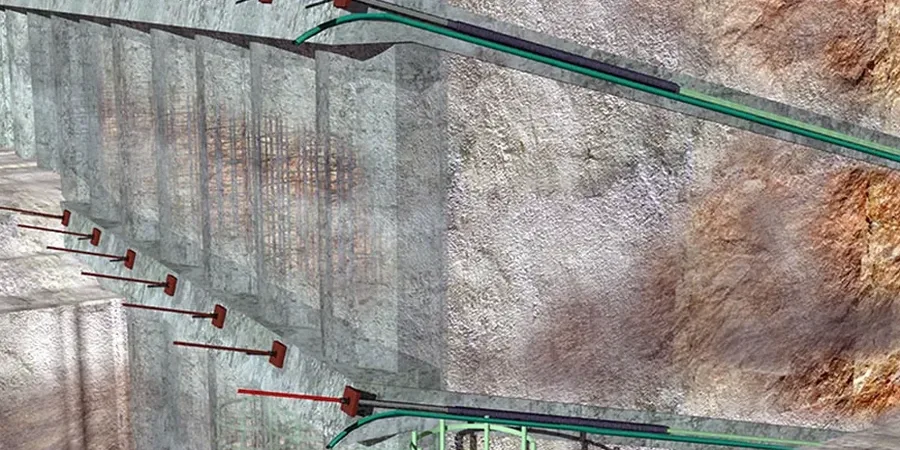
Local geotechnical conditions in Portland Oregon
A 10-story mixed-use project on a tight lot off SW Broadway encountered a nightmare scenario: the excavation support system for the underground parking had to underpin an adjacent unreinforced masonry structure from the 1920s. The initial design called for passive rock bolts, but the decomposed basalt at the site had a RQD near zero, making passive grout bond unreliable without confinement. We switched to a high-capacity active tieback system with a 60-foot bond zone into the competent Troutdale gravels. The risk of ignoring this was a progressive loss of passive resistance, which would have manifested as lateral deflection exceeding 3 inches at the wall top. In Portland’s sensitive urban grid, the verification of anchor lock-off loads is non-negotiable, especially considering the regulatory oversight on protecting historic building stock from vibration-induced settlement.
Our services
Our anchor design services cover the full lifecycle from feasibility to lift-off, executed by a team that understands the nuanced behavior of Portland’s subsurface strata under lateral stress.
Design-Build Tieback Analysis
We develop construction-ready anchor schedules specifying the total length, bond zone length, and grouting pressure limits, factoring in the site’s specific response to the Cascadia Subduction Zone seismicity.
Performance & Proof Testing Supervision
On-site supervision of incremental loading cycles, including extended creep tests on passive anchors, ensuring that movement stabilizes below 1 mm between 6 and 60 minutes under sustained load.
Forensic Diagnostics of Existing Anchors
Lift-off testing and tendon evaluation for aging retaining systems, often required for seismic retrofits of Portland’s older downtown commercial high-rises.
Common questions
What is the typical cost range for an active/passive anchor design package in Portland?
Depending on the number of anchor rows and the complexity of the subsurface profile, a full design package with load testing specifications typically ranges from US$1,060 to US$3,460. This includes the bond stress calculations, global stability checks, and the corrosion protection detailing required for the high-rainfall Portland environment.
What is the difference between an active and a passive ground anchor?
An active anchor is stressed and locked off against the wall face immediately after grouting cures, applying a pre-compressive force to the soil. A passive anchor remains unstressed and only begins to resist load once the wall deflects and engages the tendon; it relies on ground movement to mobilize its capacity.
Why is corrosion protection so critical for anchors in Portland?
The persistent high water table and acidic volcanic soils east of the Willamette create a corrosive environment for steel. We specify double corrosion protection (DCP) with corrugated sheathing and factory-applied epoxy coating on the bars, compliant with PTI DC35.1, to prevent tendon degradation over the 75-year design life.
How do you verify the bond strength in Portland’s heterogeneous gravels?
We correlate the SPT N-values from the boring logs with the cementation level of the Troutdale Formation. During installation, we log the grout take volume and pressure, and then perform a sacrificial anchor test to failure at the start of the project to confirm the ultimate bond stress before the production anchors are drilled.