The loading press in our Portland lab runs a steady rhythm this time of year, pushing a 1.95-inch piston into compacted soil specimens at 0.05 inches per minute. We have the CBR mold assemblies lined up on the bench: three-point compaction with modified Proctor effort, soaked for 96 hours to simulate the worst wetting conditions a subgrade will ever see. The Willamette Valley silt we test most often looks unremarkable in the field, but under that soaking cycle it can lose half its bearing capacity overnight. For pavement designers working on I-5 widening or a new subdivision out in Hillsboro, that number matters more than almost any other single parameter. The laboratory CBR test strips out weather variables and operator guesswork, giving a repeatable strength index tied directly to AASHTO and ODOT pavement thickness design curves.
A soaked CBR of 3 or less in Portland silts means you're designing for a subgrade that will pump under repeated loading.
Service characteristics in Portland Oregon
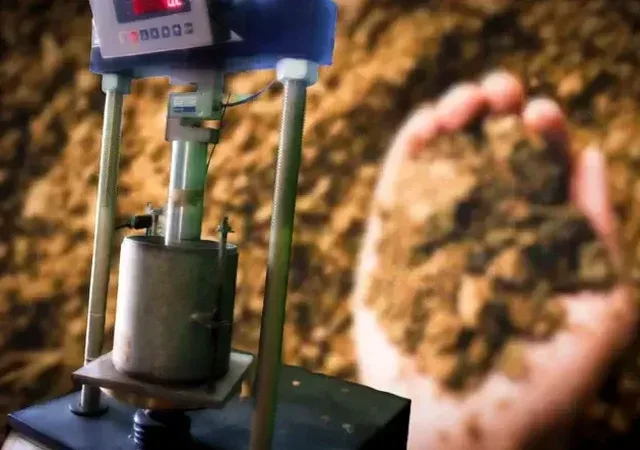
Local geotechnical conditions in Portland Oregon
The most common mistake we see in the Portland metro is a contractor who runs a field CBR on a sunny August day and assumes that number holds through February. It doesn't. The laboratory CBR test exists precisely because soaked strength is the controlling case in our climate: 155 rainy days a year, groundwater perched in the Troutdale Formation gravels, and expansive silts on the west side that heave and soften in cycles. If the pavement section is designed off an unsoaked value, the base course thickness comes out too thin, and rutting starts within three winters. We've been called out to forensic investigations on Oregon 217 and various county arterials where the cores told a clear story: the subgrade was never evaluated under saturated conditions. A plate load test in the field gives you modulus, but it won't replicate the long-term moisture equilibrium that a soaked CBR specimen captures.
Our services
The CBR value is just one piece of the pavement design puzzle. Our Portland lab supports that number with the full suite of index and strength tests needed to build a defensible subgrade report.
Soaked vs. Unsoaked CBR Comparison
We compact twin specimens from the same sample, soak one for 96 hours and test the other at field moisture. The ratio between them tells you how moisture-sensitive your subgrade actually is.
CBR with Swell Measurement
During the soaking period we record vertical swell daily with a dial gauge mounted on the tripod. Expansive soils show measurable heave, and we report it alongside the CBR number.
Correlation to Resilient Modulus
For AASHTOWare Pavement ME Design inputs, we provide the empirical correlation from CBR to resilient modulus (Mr) per the NCHRP 1-37A models, calibrated to our local materials database.
Common questions
How much does a laboratory CBR test cost in Portland?
A standard single-point CBR test, including modified Proctor compaction and 96-hour soaking, runs between US$130 and US$190 per specimen in the Portland market. The exact cost depends on whether we're testing a single sample or running a multi-point curve for pavement design optimization.
How long does the lab CBR test take from sample drop-off to report?
Standard turnaround is five to seven business days. The four-day soaking period is non-negotiable per ASTM D1883, and we need one day for compaction and setup plus time for data reduction and report generation. Rush processing can trim a day or two if we coordinate the compaction schedule.
Can you run a CBR on aggregate base material or just on subgrade soils?
We test both. For ODOT-spec aggregate base, we follow the same ASTM D1883 procedure but adjust the compaction effort and surcharge to match the material specification. Crushed aggregate with fines from local Columbia River basalt quarries typically yields CBR values above 80 percent, but we verify it with a 24-hour soak rather than the full 96 hours for subgrades.