The first thing you notice on a Portland slope job is the excavator operator’s hesitation at about twelve feet down. That’s where the Troutdale Formation gravels usually give way to the slick, weathered contact with the underlying fine-grained deposits. Our field team sets up the total station right there, often in drizzle that would kill lesser electronics, and begins correlating the exposed stratigraphy with the borehole logs from the upper terrace. We have been on enough West Hills sites to know that the interface between the loess and the fractured basalt is rarely a clean line—it undulates, it holds perched water, and it has caused more last-minute retaining wall redesigns than any other single feature in the city. A proper slope stability analysis in Portland starts with mapping that contact accurately, then running limit-equilibrium models that account for the seismic demand prescribed in the Oregon Structural Specialty Code. We use the LiDAR bare-earth data available through Metro’s RLIS to screen for ancient landslide topography before a single Shelby tube goes into the ground.
Portland’s loess can lose sixty percent of its apparent cohesion when saturated; a stability model that ignores seasonality is just a snapshot, not a design basis.
Service characteristics in Portland Oregon
Local geotechnical conditions in Portland Oregon
The Portland Hills sit on a geologic layer cake that is beautiful to look at and unforgiving to build on. The wind-deposited Portland Hills Silt, laid down during the last ice age, has a metastable structure that collapses under saturation and cyclic loading. Below it, the Troutdale Formation alternates between cemented gravel and erodible sand lenses that can daylight midway up a cut slope. When you add a seismic event—Portland is within the influence of the Cascadia Subduction Zone and capable of a magnitude 9.0 rupture—the pseudo-static horizontal acceleration can reduce a marginal slope to a flow failure. The 1896 Portland earthquake, estimated near M6.8, triggered landslides along the Willamette River bluffs that are still visible in the topography today. Skipping a site-specific slope stability analysis in the B or C seismic design categories is not just a code violation; it is a gamble with a slow-moving but highly predictable failure mechanism that insurance will not cover.
Our services
Our slope stability work in Portland integrates field investigation, lab testing, and computational modeling into a single coherent deliverable. The following services form the core of a typical West Hills or River Terrace project.
Limit Equilibrium and FEM Analysis
We construct two-dimensional profiles using Slide2 and RS2, applying the Spencer method for rotational failures and the Morgenstern-Price method for non-circular slip surfaces through the loess-basalt interface. Each model includes the design groundwater table derived from vibrating-wire piezometer data collected over at least one full wet season.
Landslide Inventory and LiDAR Screening
Before fieldwork begins, we analyze Oregon DOGAMI’s SLIDO database and process bare-earth LiDAR hillshades to identify prehistoric landslide features. This step alone has saved multiple clients from purchasing unbuildable lots in the Tualatin Mountains.
Remedial Design Recommendations
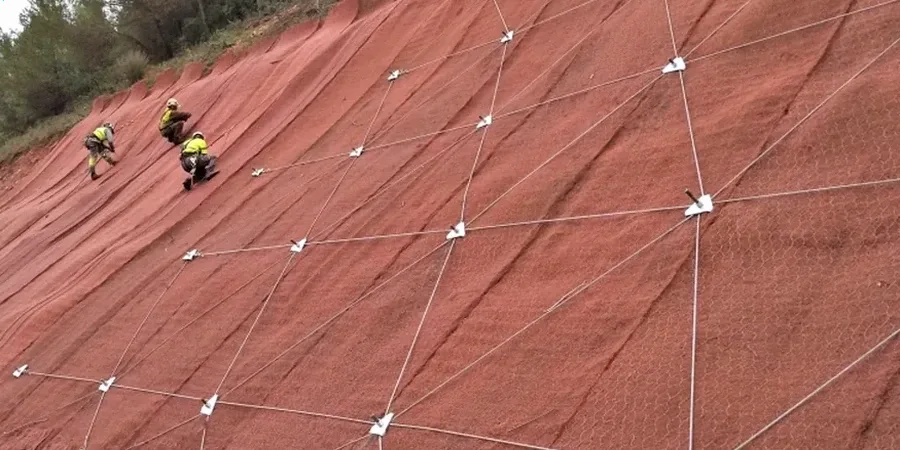
When a slope falls below the required factor of safety, we provide design parameters for tieback anchors, soldier pile walls, or soil nail arrays. Our recommendations are calibrated to the internal friction angles we measure in the lab, not generic textbook values.
Common questions
What does a slope stability analysis in Portland cost for a single-family home site?
For a residential lot requiring a slope stability analysis in Portland, the fee typically ranges from US$1,160 to US$3,800 depending on the access constraints, the number of exploratory borings, and whether the modeling must include seismic pseudo-static loading. A straightforward cut slope with one boring and a single limit-equilibrium section falls near the lower end; a complex West Hills site with multiple shear surfaces and piezometer installation moves toward the upper end.
How does the Portland Hills Silt behave differently from other silts in a stability model?
The Portland Hills Silt is loess—wind-deposited and weakly cemented. In a drained analysis, its effective cohesion drops to near zero when the collapsible structure fails. We model it with a bilinear strength envelope: a small apparent cohesion intercept for the undisturbed state, and a fully frictional envelope for the remolded state after wetting and shaking.
What triggers a mandatory slope stability analysis under Portland’s building code?
Under the OSSC, a geotechnical investigation including slope stability analysis is required when any cut or fill exceeds four feet in height within a mapped landslide hazard area, when the slope inclination exceeds 33% (roughly 3:1), or when the planned structure is located within a distance equal to the slope height from the toe or crest of a steep slope.
How do you account for the Cascadia earthquake in the analysis?
We apply a pseudo-static horizontal acceleration coefficient based on the ASCE 7-22 mapped spectral acceleration for the Portland basin, typically between 0.25g and 0.40g for Site Class D. The seismic analysis reduces the factor of safety to 1.1 or greater, and in some cases we run a Newmark displacement analysis to estimate permanent slope deformation during a design-level event.